Thursday, March 17, 2011

Growing Up With Chico (1980), Maxine Marx.

Chico, Maxine and Betty Marx

Maxine Marx's book about her experience as part of the family that gave us the Marx Brothers is deservedly well-known and much loved by classic movie fans.  Her anecdotes are funny, loving and revealing.  In some ways, the book doesn't feels as though it were written by someone in such close proximity to these famous characters, but this jives with her description of the brothers' closeness.  Even the immediate family came after the brothers, and nothing and nobody came between them.  Except maybe money.  

I enjoyed the tidbit describing Sam "Frenchie" Marx's gentle nature, which has a lot to say about women in the Marx family.  Walking home after viewing The Scarlet Letter at the movies, young Maxine asked her grandpa "why they had put the A on the lady's dress."  "Pshaw," he replied.  "Pshaw."  After a bit, he added, "Don't tell der Mamma vhat you saw, yah?"

I knew very little about Chico although he was always my favourite performer in all the movies what with the finger shooting and the  "Attsa boy, make a big slam! Make a big, big slam!"  Now I am in awe of  tough little Betty Marx for putting up with all his shenanigans.  Still, Chico manages to come across as charismatic.   I'm glad the mafia didn't whack him after all.


Tuesday, March 15, 2011

Blame it on Rio (1984), Stanley Donan.

Oh, man.  She's wearing a retainer and everything.

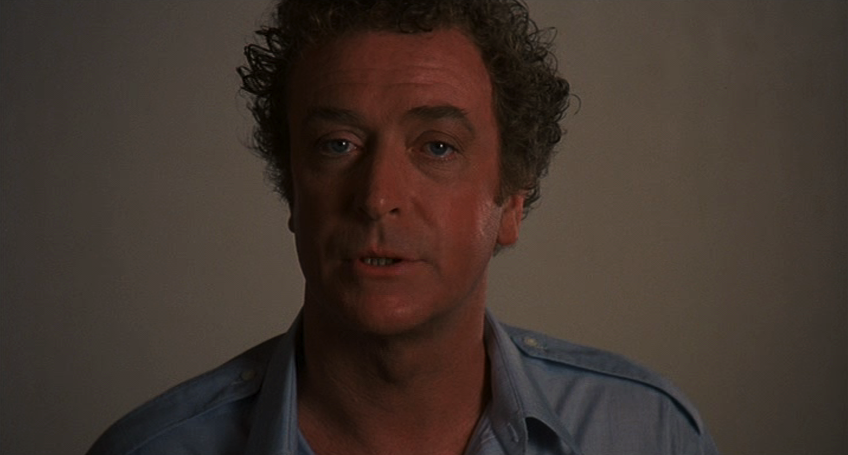
Blame it on Rio is a distasteful sex farce that is also quite funny. Plus, Joseph Bologna actually speaks the title of the film as dialogue, which always feels like earning points.  But what I want to know is:  explain to me the magic of Michael Caine's hair.  I have hair straight as a poker.  How do you get curly hair to stand down?  Fine tooth comb and Brylcreem?

This is not from Blame it on Rio, but from The Hand.  Wild hair at its most psychologically disturbed.  

All tidied up, yet still:  the curls are quite tight.

Ripply smooth!  What are the mechanics? And how much do these glasses weigh, exactly?

Sunday, March 13, 2011

A Rainy Afternoon with Vincent Price

The weather is dreadful, slushy and gloomy.  But that's OK, because I have a few Vincent Price products to keep me entertained.  We'll start with A Treasury of Great Recipes, a cookbook written with his second wife Mary.  This is a round-the-world tour of the best restaurants and includes (in addition to the washable vinyl cover) full colour plates of the couple cooking and eating their way through exciting mid-60s dishes.  I hate to say, this cookbook makes me feel hugely inadequate.  I have never dined in Paris' oldest and best restaurants!  But never mind, he's generously shared the menu and a selection of recipes I can attempt to recreate.   I especially love the personal touch: views of their kitchen and of course here on another page we have the Prices hosting a dinner in a mobile home.  "We drive out into the country or to the seashore, park where we please and picnic in style," he writes.  Generous to share the world's bounty but not a snob, the Prices' book includes homestyle American recipes alongside those of the grand cuisines of old Europe.  Let's put the cornish game hens on, from the Hostellerie de la Poste restaurant in Burgundy.  Basically you dunk two birds in cream, butter AND bechamel sauce.  But this is also an era where, apparently, you put mayo and Worcestershire sauce in the guacamole, so I'm up for the challenge.

Dining aboard the Clark Cortez "mobile home".  I guess fine dining includes a standard poodle! 

While the birds are cooking, I'm going to rehearse a few lines with Mr Price.  This is so dreamy I can't get over it, thank goodness I lust after debonair, middle-aged ham actors and not that teenaged shirtless werewolf from Twilight.  Gosh, to be going over my enunciation skills in the privacy of my own rec room.  


But my basement has always been a bit drab, I guess I never gave too much thought other than a coat of paint and some posters.  That must change!  Luckily, I can learn about purchasing original artworks from Mr Price.  1962, Price personally selected a number of affordable but original artworks to be sold through Sears Roebuck.   I guess the business model was hard to sustain, but I'm going to take a few notes anyway and see if I can find anything decent in the local art gallery.  

Casino (1995), Martin Scorsese.

Pivotal, hugely entertaining scene.  "I know, but that's enough."

Martin Scorsese's last great movie, if you ask me.  Starring real men.  A visual feast.  With an actual female character.  And it's all fucking true!  Las Vegas is somewhere I don't need to go, even if just to make that once in a lifetime trip to cross it off some kind of (ugh) must-do list mandated by airport non-fiction.  1000 Places to See Before You Die.  Forget that self-help fascism.  The old Vegas has been bulldozed and the new corporate Vegas (sans Liberace Museum) keeps pulling in the rubes.  I guess the middle classes flock there because it's sanitized and safe but they can still pretend they're palling with the Rat Pack.  Why not just go to Orlando?

Martin Scorsese's such a big booster for film preservation, and his love of B-noirs is so genuine that I have mixed feelings about pulling him down.  But I think his failure has been to choose DiCaprio for his male muse.  I am pretty much in agreement with Erich Kuersten's thesis that movies today lack real men. (Kuersten is the author of the Acidemic blog:  http://acidemic.blogspot.com).  Kuersten observes:  "DiCaprio has never been married or had children.  He dates models.  Not that there's anything wrong with that, but it shows at least on the surface, a level of laddish insecurity; his women must be certified gorgeous in case someone's looking."  I am not a deep thinker but yeah, I think strong male performances must be rooted in life experience and maybe we don't have Alpha Males in films today because, well, where are they, and who wants to hire them?  Hey, I married a mensch but it doesn't mean I don't want to see male rage and sexuality onscreen.  And Scorsese's films continually explore masculinity and male relationships.  I could probably find you a half dozen real manly men but they'd be coming from up north in lumber camps and from shrimp boats on the coast.  Are these guys trying out for Hollywood parts these days?  Can you imagine an established, risk-averse Hollywood exec grooming Mr Fort McMurray these days?  I can't.  Scorsese followed Casino with Kundun, Bringing out the Dead and then settled into what would remain basically an unbroken pattern for the next decade and a half, casting DiCaprio in Gangs of New York.  Gangs to me is as baroque as Casino but structurally a mess, performance-wise hugely uneven and a disaster one inch from stumbling into becoming a Broadway musical dance sequence.  Sorry, I hated it and I think part of the problem was making a boy its central focus.

And yeah, I am a girl.  I love the costumes in Casino.  I guess I bought the DVD to watch De Niro wear cantaloupe pants.  Sharon Stone is batshit and I love that she's hung up on James Woods -- trying to figure her out is impossible and she's such dynamite next to De Niro's performance which is highly restrained until he loses his gaming license and bursts forth like a geyser of angry bitterness.  I always suffer a Pesci hangover after watching him zip up his pants in that one scene, but Casino is a great, adult film and a gutsy goodbye to the original Las Vegas.

Who else can pull off burnt orange on burnt orange with a burnt orange tie?

The Man With Two Faces (1934), Archie Mayo.


A little undercooked cake of a movie, The Man With Two Faces is passable fare and mostly of interest as as one of Edward G Robinson's earlier screen performances (it was not widely released to DVD but is available through the Warner Archive Collection).  Adapted from the stage play The Dark Tower, the simplistic story revolves around a theatrical sleight of hand.  Mary Astor and Edward G Robinson play siblings in the same profession:  stage actors.  Mary's career is jeopardized when her shady, itinerant husband lands on their doorstep after a stint in San Quentin.  Despite what we are told (always less effective than what we observe), her husband (played by Louis Calhern) comes across as more of an eccentric jerk than anyone deserving to be chopped into tiny pieces.  Edward G Robinson plays a strangely conceived character who is equal parts cad and saviour.  He is overly fond of his beer and slapping his wife around a bit - yet we're not supposed to dislike him as much as Louis Calhern!  The very naturalistic Henry O'Neill adds a few laughs as the police inspector  making Robinson squirm. Verdict:  a little jiggly in the centre but worth a nibble.

Edward G Robinson gives "acting lessons" to Mae Clarke

Tuesday, March 8, 2011

"The Movies Are": Carl Sandburg's Film Reviews and Essays, 1920-1928 (2000) Edited by Arnie Bernstein.

Inside the playhouse are movies from under the sea.  From the heat
of the pavements and the dust of sidewalks, passers-by go in a
breath to be witnesses of large cool sponges, large cool fishes,
large cool valleys and ridges of coral spread silent in the soak
of the ocean floor for thousands of years.
"In a breath," Carl Sandburg, from Chicago Poems, 1916.


Silent movies are to me a strange, hermetic medium.  I feel as though I am entering a different dimension, swimming underwater in a slow moving stream where everything is lovely and exaggerated.  Reading Carl Sandburg's columns on films, which he wrote for the Chicago Daily News in the 20s, I was pleased to realize that even silent movies were once a fun, popular, living and growing medium.  They were also just as lacking in creativity (with umpteen Sheik-a-likes), notorious for overblown budgets, offensive and scandalous as they are today.  Carl Sandburg gave Charlie Chaplin a free pass for life and got fussily irritated when they got Swedish accents wrong.  That a title card can get an accent wrong is kind of wonderful.  He did not view The Jazz Singer as a milestone  because he'd sat through many different kinds of experimentalism before.  Sandburg's prose is delightful and breezy.  I'm quite glad I stumbled onto knowing that such a great poet happily tackled pop culture.  Who do we have covering the 30s?

Sunday, February 27, 2011

The Hepcat and the Man: Biographies of Robert Mitchum and Henry Fonda

Talk about two different hombres!  Within the last couple weeks, I read the biographies of Henry Fonda and Robert Mitchum simultaneously (Fonda:  My Life, "as told to" Howard Teichmann and Robert Mitchum: Baby I Don't Care by Lee Server).  Fonda's biography has as its focal point Fonda's stage performance in Mister Roberts, a Second World War yarn with an all-male cast symbolizing the virtues of one generation of American males.

Lee Server's book is clearly the superior literary product; its words leap off the page in a playful way and contains a mind-boggling number of interviews including one that was prefaced with, "well who cares, everyone is dead now" (juicy, juicy stuff)!  Server depicts Mitchum fondly but doesn't let him off the hook --  hey, his colleagues either loved or hated him, and even his wife described him as a bachelor at heart.  What do you make of a guy whose ultimate pet projects end up as Thunder Road, a Southern trash movie about moonshine and muscle cars that "would foster a rabid underground following." Or what about the idea of becoming Calypso's "white hope" by cutting an LP titled Calypso - is like so... ?

Is like so... freaking hilarious

And then we have Henry, who upon returning from naval duty in the war showed his son Peter the medal he had earned.  Within twenty minutes Peter had lost it forever somewhere in the long grass in the backyard.  I can just picture the look on Fonda's face, which is usually also the best look in all his movies:  a combination of contempt, moral superiority and silent rage.  Henry Fonda can clear a saloon with one dirty look but I am glad he wasn't my dad.  While seemingly polar opposites this might be the thread that connects these two dudes:  rage.  Cape Fear and Night of the Hunter: Mitchum's uncontrollable rage make both unforgettable.  If Mitchum had been nothing but a lazy doobie-loving cat and if Henry Fonda had been just a starchy authority figure we probably would have forgotten both by now.

Death on the Cheap: The Lost B Movies of Film Noir (2000) Arthur Lyons.

Arthur Lyons' book Death on the Cheap is a handy reference to the elusive noir genre.  Lyons recognizes the B roots of noir and rightly identifies the B-units of mainstream studios as the starting point for noir, but also dredges through Poverty Row output identifying significant contributions to the genre.   As Gerald Petievich points out in his introductory essay, "thankfully, the terms mise-en-scene, aesthetic reversals and rhetorical form do not appear in his text"; likely because Lyons is writing more of a straight history and not an aesthetic analysis.  Lyons situates these products within an economic context with roots in pulp novels and comics.  He defines a noir as a crime picture, where the characters live in an "unforgiving universe" and all players, even the good guys, are "uniformly corrupt."  The book, which is essentially a listing of key films that came to be associated with the genre, benefits greatly from Lyon's clear-headed description of the beginnings, peak and aftermath (including the re-interpretation) of film noir.